You wake up, pull back the curtains, and there it is. A jagged, unwanted scrawl across your beautiful brickwork. It’s a gut-punch moment that instantly turns pride into frustration! We know exactly how you feel. You’re likely worried about permanent "ghosting" shadows or the potential costs of professional help. You might even be dreading the slow wait for a council response whilst the paint sets deeper into the stone. It’s a total headache!
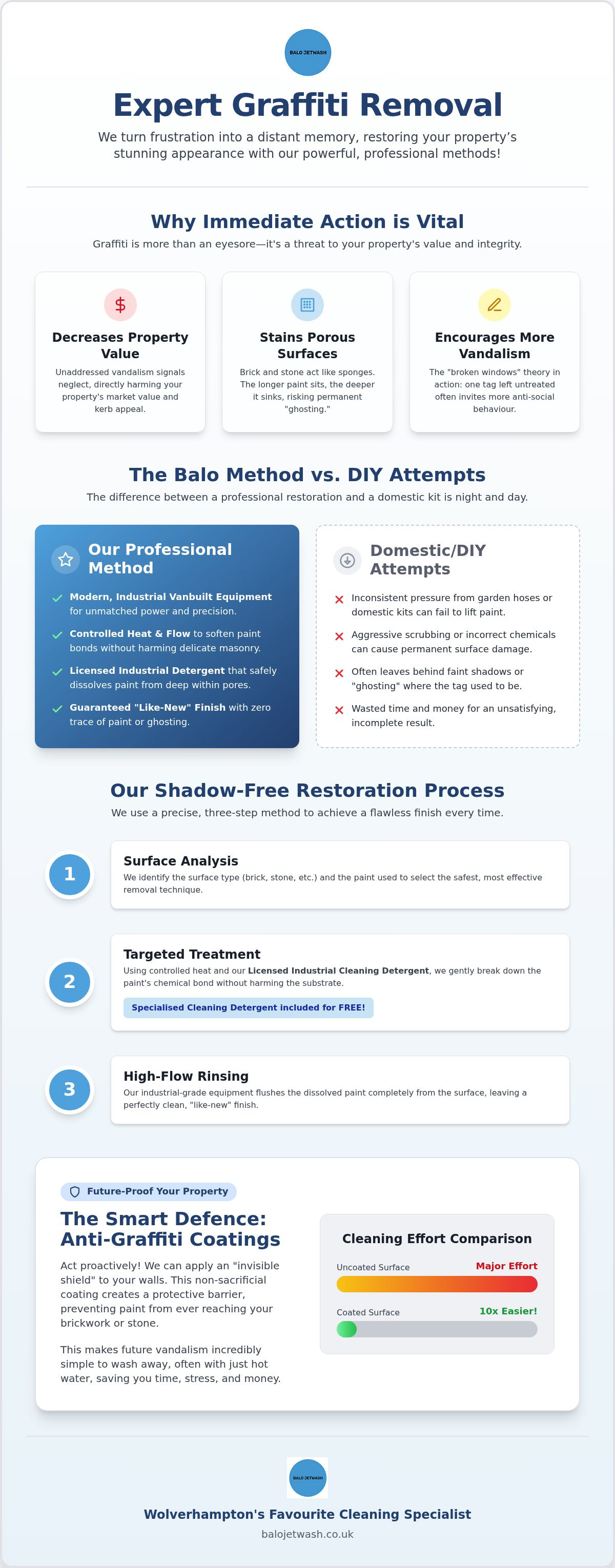
But don't panic! Our expert graffiti removal Wolverhampton service is designed to turn that stress into a distant memory. We promise to eliminate unsightly vandalism quickly and safely using professional techniques that restore your property’s stunning appearance. We use Modern, Industrial Vanbuilt equipment and Licensed Industrial Cleaning Detergent to ensure a "like-new" finish with no trace of paint left behind. We even include a Specialised Cleaning Detergent for FREE in our specialised cleans!
In this article, we’ll show you how our rapid-response team protects your investment. You’ll discover the secrets to shadow-free restoration and get expert advice on preventing future attacks. Let’s get your property looking its best again!
Key Takeaways
Learn why immediate action is vital to protect your property’s value and prevent further vandalism from occurring. Discover how our expert graffiti removal Wolverhampton service uses Modern, Industrial Vanbuilt equipment to safely achieve a stunning, "like-new" finish. Understand why professional services are often faster and more reliable than council removal for private homes and businesses. Explore the benefits of anti-graffiti coatings that act as "invisible shields" to make future cleaning 10-times easier whilst protecting your surfaces. See how our use of Licensed Industrial Cleaning Detergent and FREE inclusions ensures no trace of paint or "ghosting" remains on your property.Graffiti in Wolverhampton: Why Immediate Action is Vital
Vandalism is a shock to the system. You’ve worked hard to maintain your property, and seeing it defaced is incredibly frustrating! But graffiti is far more than just a visual eyesore. It’s a direct hit to your property’s market value. In Wolverhampton, we’ve seen how quickly a single tag can change the feel of an entire street. If you leave it, you’re essentially sending an invitation for more. This is the "broken windows" theory in action. It suggests that visible signs of neglect encourage further vandalism and even anti-social behaviour. We’re here to help you break that cycle immediately!