
Will Pressure Washing Damage Roof Tiles or Cause Leaks?

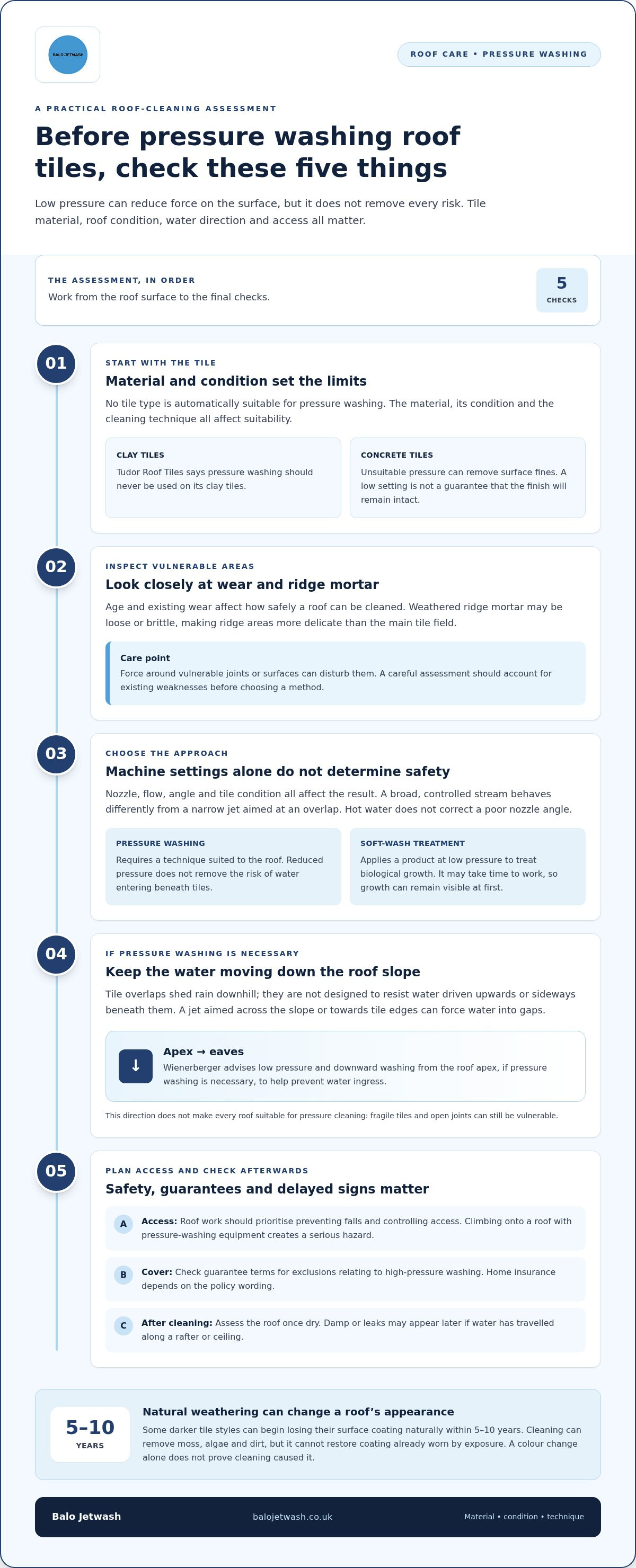
Low pressure does not guarantee that roof tiles will stay undamaged. If you’re asking, “Will pressure washing damage my roof tiles in Four Oaks?”, the answer is yes: it can erode tile surfaces, disturb ridge mortar or force water beneath tile overlaps. Wienerberger advises that, if pressure washing is necessary, it should be done at low pressure, with water directed downwards from the roof apex to help prevent water ingress.
It’s understandable to want a quick way to clear moss and algae, especially when a roof looks tired. But whether pressure washing damages roof tiles depends on their material and condition, as well as the cleaning technique. Even careful cleaning can expose existing weaknesses.
This guide explains how pressure affects roof tiles, why even low-pressure cleaning can carry risks, and what to look for in weathered tiles or loose ridge mortar. It also covers how damage can lead to leaks that appear after cleaning, helping you make a more informed decision about your roof in Four Oaks.
Key Takeaways
Low pressure can still drive water beneath tile overlaps if the nozzle angle or direction is unsuitable. Tile material, age and existing wear all affect how safely a roof can be cleaned. Weathered ridge mortar may be vulnerable to water pressure, increasing the chance of water entering the roof space. Damage to tiles or mortar can lead to leaks that appear after cleaning, so signs of damp may need attention. Professional roof pressure washing should be adapted to the roof’s condition, using suitable pressure and technique.Does low pressure roof cleaning change this conversation?
Low pressure reduces the force hitting the tiles, but does not remove the risk of water entering beneath them. Nozzle direction, tile condition and the roof’s overlapping design all matter during cleaning.
Water ingress beneath overlapping tiles
Water ingress can happen when a jet pushes water beneath the raised edge of a tile and into the overlap below. The overlap sheds rain downhill, but it isn’t designed to resist water driven upwards or sideways under pressure.
A nozzle aimed across the slope, towards the tile edges, can force water into gaps that ordinary rainfall doesn’t reach. Even at reduced pressure, a concentrated stream may pass beneath overlapping tiles and wet the roof space or underlay. The first sign may be delayed: water might not appear indoors until it has travelled along a rafter or ceiling.
Downhill washing direction
Downhill washing follows the roof’s natural water flow, from the apex towards the eaves. This helps prevent water being driven beneath tile overlaps. Wienerberger advises that, if a pressure washer is necessary, it should be used at low pressure and directed downwards from the apex to help prevent water ingress.
Direction matters because tile courses overlap like scales. A stream directed uphill can strike the lower edge of an upper tile and push water underneath. Washing down the slope lets water run over the tile faces, but does not make every roof suitable for pressure cleaning. Fragile tiles and open joints can still be vulnerable.
Low-pressure and hot-water cleaning
Low-pressure cleaning reduces the force hitting the tile, while hot water changes the temperature of the cleaning water. Neither setting alone shows that a roof can be washed safely: the nozzle, flow, angle and tile condition also affect the result.
A broad, controlled stream directed downhill behaves differently from a narrow jet aimed at a tile overlap. Hot water cannot correct a poor nozzle angle, and low pressure can still push water into a gap if the stream points against the roof’s slope. Cleaning decisions should account for the material and existing wear, not just the machine setting.
Tile types, safety and cover
No tile type is automatically safe to pressure wash. Suitability depends on the material, condition and cleaning technique. Tudor Roof Tiles says pressure washing should never be used on its clay tiles. Concrete tiles can also lose their surface fines under unsuitable pressure, so a low setting does not guarantee their finish will remain intact.
For UK roof work, safety planning should focus on preventing falls and controlling access. Climbing onto a roof with pressure-washing equipment creates a serious hazard. Tile or roof guarantees may be affected if their terms exclude high-pressure washing. Home insurance depends on the policy wording, so don’t assume roof cleaning automatically preserves or cancels cover. Read the relevant documents before work begins.
Natural weathering after treatment
Roof tiles continue to weather after cleaning, so a brighter surface may not keep the same appearance indefinitely. Some darker tile styles can begin losing their surface coating naturally within 5-10 years. Cleaning can remove moss, algae and dirt, but it cannot restore a coating already worn by exposure. That distinction matters: a change in colour after treatment may reflect the tile’s condition, rather than damage caused during cleaning.
A soft-wash treatment applies a product at low pressure to treat biological growth, rather than relying on a forceful stream to remove it. The treatment may take time to work, so the roof’s appearance can change gradually rather than becoming uniformly clear straight away. Moss or algae may remain visible while the treatment takes effect. The tile surface and remaining growth both influence the result.
Low pressure still needs careful control. A broad, gentle application across a vulnerable surface can have a different effect from a controlled application suited to the tile and roof condition. The aim is to address organic growth without excessive abrasion or stripping the tile surface. Treatment cannot reverse natural weathering, and a visibly worn or delicate surface needs particular care before choosing any cleaning method.
Ridge areas deserve special attention because they can be more delicate than the main tile field. Avoiding force around the ridge helps reduce disturbance to vulnerable surfaces and joints. Where a soft-wash or biocidal treatment is appropriate, allowing it time to work means immediate removal is not the only measure of success. Loose or weathered ridge material should not be subjected to the same force as sound tile faces.
After treatment, assess the roof in stages rather than judging it only while wet. Once the surface has dried, look for patches where coating loss, fading or uneven colour is clearer. Compare them with sheltered sections, which may have weathered differently. A naturally worn finish can look less even once dirt and growth no longer disguise it. That appearance alone doesn’t prove cleaning caused the change.
Choose a cleaning method for the tile material, surface condition and sensitive areas, not just the amount of moss present. A soft-wash approach may suit a roof where reducing mechanical force matters, while pressure washing requires careful control. Treat delicate ridge details cautiously, and allow time for any remaining biological growth to respond. These distinctions help separate gradual weathering from avoidable cleaning damage.
Tiles need care: avoid force and allow soft-wash or biocidal treatments to work over time, rather than expecting immediate removal.
Ridge mortar condition and cleaning risks
Ridge mortar secures the tiles along the roof’s peak, but weathering can leave it loose or brittle. In some cases, ridge pointing may have gone without maintenance for 20 years or more. A pressure washer can dislodge weak mortar, opening gaps where rainwater may enter the roof cavity.
This risk can be easy to miss from the ground. A ridge may look continuous while containing small cracks or areas where mortar has separated from the tiles. A strong water jet can widen weak spots or blast away loose pointing. Water entering at the ridge may then travel into the roof space rather than appearing directly beneath the damaged section.
Pressure washing can also affect the tiles themselves. An unsuitable stream may loosen or break tiles, damage their bonding, or remove surface material from concrete tiles. Even a small area of disturbed ridge mortar can leave tiles less secure and create a route for water. The National Federation of Roofing Contractors says moss growths do not normally damage tiles or slates, and warns against potentially damaging power washing.
Consider the roof’s condition before cleaning, not just how much moss is visible. From a safe position, look for cracked ridge mortar, displaced tiles and uneven roof lines. After cleaning, inspect the ridge pointing again. Damaged pointing needs repair. A clean tile surface does not show whether the mortar around or beneath the ridge remains sound.
A DIY pressure washer adds another risk: the person cleaning must control the equipment while working at height. Roof access, slippery tiles, hose movement and a forceful jet can make balance and nozzle control difficult. Aiming at the ridge to remove stubborn growth may disturb mortar that already needs repair. A ladder-based attempt can also leave areas difficult to see and reach safely.
Never treat a pressure washer’s setting as proof that a roof can withstand cleaning. Tile material, existing cracks, loose mortar and access all affect the risk. If ridge mortar is already failing, cleaning may expose or worsen the weakness. A roof unsuitable for cleaning should not be pressure washed, even at low pressure. Its condition comes first.
For example, if the ridge has gaps and a tile moves, the concern is structural security, not simply moss removal. Avoid directing a jet at that area, and have the damaged pointing or tile assessed and repaired. Cleaning is not a substitute for necessary roof maintenance.
Potential delayed leaks after cleaning
A roof leak may become visible after cleaning, even if the first signs appear later. Water can pass through a damaged tile channel or disturbed overlap, then travel along a rafter before reaching the ceiling. A wet patch indoors may therefore be some distance from where water entered, making the original damage harder to identify.
Jet washing may break tile channels and create a route for water, particularly where tiles are already fragile or cracked. For example, a concrete tile with a damaged edge may allow rain beneath its covering after cleaning. The roof space can become damp before a ceiling stain appears. That delay does not prove cleaning caused the leak, but it makes a careful roof inspection useful.
Look for changes after cleaning, especially after rain. From inside the loft, check the underside of the roof covering, rafters and insulation for fresh dampness or water marks. Indoors, note new ceiling discolouration, peeling paint or a musty smell. Record where each sign appears and compare it with the roof slope and nearby tiles. Don’t walk on the roof to investigate.
Fresh damp timber: Check rafters beneath the area where water marks appear. Wet insulation: Note whether it sits below a tile run or roof junction. New ceiling marks: Photograph the position and watch for changes after rainfall. Loose or cracked tiles: Keep clear of the roof and arrange a safe inspection.
These signs may point to a pre-existing defect exposed by cleaning, rather than damage caused by it. Moss can conceal cracks or movement, while water entering through an older weakness may only become noticeable after rain. A stain beneath a ridge, for example, could relate to displaced tiles, damaged pointing or another route into the roof space. The visible mark alone cannot identify where water entered.
If you have photographs, compare the affected area with the roof’s condition before cleaning. A picture showing an intact tile course can help distinguish a new break from an older defect. Note when the first indoor sign appears and whether rainfall makes it worse. These details give a roofer a clearer starting point when tracing water through the roof structure.
Don’t dismiss a small stain just because it dries between showers. Water can follow timber or underlay before appearing indoors, so the ceiling mark may not be directly below the fault. If dampness returns after rain, treat it as a sign that water is still entering. Prompt attention to cracked tiles or broken channels can help prevent further water reaching the roof space.
Pressure levels for washing roof tiles
There isn’t one pressure setting that makes every tiled roof safe to wash. The Roof Tile Association advises against using a high-pressure water jet on roof tiles because it can erode their surface and shorten their lifespan. The key is to assess the roof, equipment and technique together, rather than relying on the pressure figure alone.
Pressure is commonly shown in pounds per square inch (PSI), but the number alone doesn’t describe the force reaching a tile. Nozzle type, water flow, distance from the surface and stream angle also affect its impact. A narrow jet held close to a tile, for example, can concentrate force on a smaller area than a broader stream held further away.
Some guidance describes professional roof-cleaning pressure washers as operating between 2,000 and 3,000 PSI, depending on tile type and condition. It also describes machines rated at 4,000 PSI or higher as excessive for roof tiles. These figures shouldn’t be read as a safe setting for every roof: the same pressure can affect weathered concrete tiles differently from sound tiles.
Concrete tiles need particular care because excessive force can remove their surface fines. These fine surface particles contribute to the tile’s finish, and losing them can affect its lifespan. An unsuitable nozzle, excessive pressure or high water flow can strip this material. A roof with worn, brittle or previously damaged tiles needs a different assessment from one with sound surfaces.
Low-pressure cleaning aims to remove organic growth without excessive abrasion or stripping the tile surface. But “low pressure” does not fully describe the method. A stream directed into joints, applied too close, or used with high water flow can still cause problems. The technique must suit the tile and its condition, rather than relying on the machine’s label.
Before work, ask practical questions: what material are the tiles, how weathered are they, and what nozzle and direction will be used? Consider pressure alongside those details. If moss or algae remains, an appropriate treatment may help address biological growth without increasing mechanical force. The roof’s condition still determines whether washing is suitable.
For homeowners in Four Oaks, the clearest takeaway is simple: don’t choose a roof-cleaning method by PSI alone. The Roof Tile Association’s warning about high-pressure jets makes tile protection central to the decision. Pressure, flow, nozzle, angle and surface condition all influence the outcome. A setting cannot make a vulnerable roof suitable for washing.
Balo Jetwash: driveway Cleaning
Balo Jetwash provides roof cleaning for homeowners concerned about moss, dirt and algae on roof tiles in Four Oaks and across the West Midlands, including Wolverhampton and Sutton Coldfield. The approach should suit the roof’s material and condition, rather than rely on an uncontrolled jet. Where appropriate, a cleaning treatment can help address biological growth. Damaged tiles or loose ridge mortar need attention before cleaning, since pressure can worsen existing weaknesses.
Balo Jetwash also offers driveway and patio cleaning, removing stubborn dirt, algae and moss from outdoor surfaces. The right service depends on the surface and its condition. Contact Balo Jetwash to discuss roof cleaning or another exterior cleaning service in Four Oaks, Wolverhampton or Sutton Coldfield.
Make a careful next move for your roof
If you’re wondering, “Will pressure washing damage my roof tiles in Four Oaks?”, start by noting what you can safely see from the ground. Record the tile type if known, visible cracks, loose ridge mortar or signs of damp indoors. These details help focus the decision on your roof’s condition, rather than choosing a cleaning method based only on appearance.
Don’t climb onto the roof to inspect it yourself. A professional assessment can help determine whether pressure washing suits the tiles and which approach fits them. If the roof has damaged areas, address those concerns before making cleaning the priority. A considered plan is a better starting point than rushing towards a brighter finish.
For a roof-cleaning discussion focused on your property, contact Balo Jetwash about roof cleaning. Take the next step with a clearer picture of your roof and the care it needs.
Frequently Asked Questions
Can pressure washing damage concrete or clay roof tiles?
Yes, pressure washing can damage both concrete and clay tiles if the force or technique is unsuitable. Concrete tiles may lose their surface fines, whilst clay tiles can be vulnerable to surface damage. Concrete tiles from the 1970s and 1980s are often more brittle than they appear. Clay tiles can also be prone to spalling in freezing weather, so existing wear matters when assessing cleaning risk.
What damage can high-pressure washing cause to roof tiles and underlay?
High-pressure washing can erode tile surfaces, crack or loosen tiles, and push water into the roof space. Water passing through a damaged tile channel may wet the underlay, insulation or timber beneath it. The first indoor sign could be a ceiling mark some distance from where water entered. After cleaning, note any new damp patches and whether they worsen after rainfall.
What pressure and nozzle are safe for cleaning roof tiles?
There’s no single pressure or nozzle that’s safe for every roof. The Roof Tile Association advises against high-pressure water jets because they can erode tile surfaces and reduce their lifespan. If pressure washing is necessary, Wienerberger advises using low pressure, directed downwards from the apex. Don’t treat a machine setting as a guarantee: tile material, condition, nozzle and water flow all affect the force reaching the roof.
What is the recommended way to remove moss from roof tiles in the UK?
Use a method suited to the roof’s material and condition rather than assuming moss always needs removal. The National Federation of Roofing Contractors says moss growths don’t normally damage tiles or slates and warns against potentially damaging power washing. Where cleaning is appropriate, Balo Jetwash provides controlled roof cleaning; a suitable treatment may help with any remaining biological growth. A roof unsuitable for cleaning should not be washed.
{"@context":"https://schema.org","@type":"FAQPage","mainEntity":[{"@type":"Question","name":"Can pressure washing damage concrete or clay roof tiles?","acceptedAnswer":{"@type":"Answer","text":"Yes, pressure washing can damage both concrete and clay tiles if the force or technique is unsuitable. Concrete tiles may lose their surface fines, whilst clay tiles can be vulnerable to surface damage. Concrete tiles from the 1970s and 1980s are often more brittle than they appear. Clay tiles can also be prone to spalling in freezing weather, so existing wear matters when assessing cleaning risk."}},{"@type":"Question","name":"What damage can high-pressure washing cause to roof tiles and underlay?","acceptedAnswer":{"@type":"Answer","text":"High-pressure washing can erode tile surfaces, crack or loosen tiles, and push water into the roof space. Water passing through a damaged tile channel may wet the underlay, insulation or timber beneath it. The first indoor sign could be a ceiling mark some distance from where water entered. After cleaning, note any new damp patches and whether they worsen after rainfall."}},{"@type":"Question","name":"What pressure and nozzle are safe for cleaning roof tiles?","acceptedAnswer":{"@type":"Answer","text":"There’s no single pressure or nozzle that’s safe for every roof. The Roof Tile Association advises against high-pressure water jets because they can erode tile surfaces and reduce their lifespan. If pressure washing is necessary, Wienerberger advises using low pressure, directed downwards from the apex. Don’t treat a machine setting as a guarantee: tile material, condition, nozzle and water flow all affect the force reaching the roof."}},{"@type":"Question","name":"What is the recommended way to remove moss from roof tiles in the UK?","acceptedAnswer":{"@type":"Answer","text":"Use a method suited to the roof’s material and condition rather than assuming moss always needs removal. The National Federation of Roofing Contractors says moss growths don’t normally damage tiles or slates and warns against potentially damaging power washing. Where cleaning is appropriate, Balo Jetwash provides controlled roof cleaning; a suitable treatment may help with any remaining biological growth. A roof unsuitable for cleaning should not be washed."}}]}
Information
Water available? - You don't need to be present for us to carry out the service. If required, we can supply water ourselves.
Insurance
Balo Jetwash is fully insured, We have £5,000,000 of public liability insurance. Balo Jetwash operatives are professional, reliable and endeavour to carry out the work to the highest standard with minimal fuss and upheaval.