
Removing Rust Stains from Patio Slabs: A Practical Sutton Coldfield Guide

Removing rust stains from patio slabs takes more than choosing the strongest cleaner or highest pressure setting. If a rust-coloured mark is spoiling your patio, first identify the paving and look for a possible source. Metal furniture, planters, corroded fixtures or iron-containing garden products could all leave discolouration.
It’s understandable to want a conspicuous stain gone quickly, especially if you’re unsure whether your slabs are natural stone, porcelain or concrete. The wrong treatment can discolour or damage the surface, and pressure washing alone may not lift a mark that has settled into porous stone.
This guide explains how to investigate the stain, choose a cautious treatment for your paving and know when to stop DIY attempts. You’ll also find practical ways to reduce the chance of new marks and learn when professional patio cleaning may help. For patio cleaning in Sutton Coldfield and Wolverhampton, Balo Jetwash uses modern, vanbuilt industrial-grade equipment. Free re-sanding with Klin dried sand and specialised cleaning detergent are included. A careful plan can improve your patio’s appearance without risking unnecessary damage.
Key Takeaways
Orange-brown marks can come from metal items, garden products or iron within the paving, so colour alone won’t reveal the source. Identify whether your slabs are natural stone, limestone, sandstone, porcelain or concrete before choosing a treatment. Move furniture and clear loose debris carefully, then treat the mark cautiously and assess the result before doing more. Reduce the risk of new marks by keeping corroding items off the slabs and clearing garden products according to their label. Balo Jetwash provides Patio Pressure Washing & Cleaning in Sutton Coldfield and Wolverhampton. General washing can refresh the wider surface, but it can’t guarantee complete removal of a localised mark.Why Do Rust Stains Appear on Patio Slabs?
An orange-brown mark can stand out sharply against pale paving, but its appearance doesn’t tell the whole story. A rust stain is discolouration associated with iron compounds on or within a slab. Rust forms as iron reacts with oxygen and moisture; Understanding Rust: The Chemical Process offers a useful overview. On a patio, the iron may come from an item resting on the surface or be present within the paving itself.
Look for a pattern. A ring beneath a metal chair or plant stand may point to direct contact. Scattered spots could suggest splashes or particles carried across the surface. If marks return in exactly the same area after you move the suspected source, the cause may be less obvious. These clues can help guide your next step, but they don’t prove the source on their own.
Common sources of orange-brown patio marks
Check what sits on or near the affected slabs. Rusting feet on garden furniture, plant stands, tools and metal containers can leave marks where they touch the paving. Corroding fixtures can also contribute, particularly where rainwater runs over them and onto the patio.
Iron-containing garden products are another possible source. If granules or liquid land on paving, they may leave scattered marks. Rain can carry colour away from the original contact point, creating a trail or wider patch. Look uphill from the stain and check the path rainwater follows, as well as the immediate area.
Transferred rust comes from an external iron source; discolouration emerging within paving may be linked to iron-bearing material in the slab itself. That distinction matters. Treating a mark repeatedly without identifying its likely origin may not solve the underlying problem.
When the stain may come from within the slab
Some natural stone contains iron-bearing minerals. If these minerals meet moisture and air, discolouration may develop from within the stone rather than transfer from furniture or a garden product. If a mark returns in one spot, reassess its possible source before repeating the same treatment.
Don’t diagnose the paving from a photograph or stain colour alone. Slabs can look similar while being made from different materials, and orange-brown marks can have more than one cause. Note where the marks appear, whether they form a pattern and whether anything rests above them. Balo Jetwash also provides roof cleaning and moss removal as part of its exterior cleaning services in Sutton Coldfield and Wolverhampton.
How to Choose a Rust Treatment Without Damaging Patio Slabs
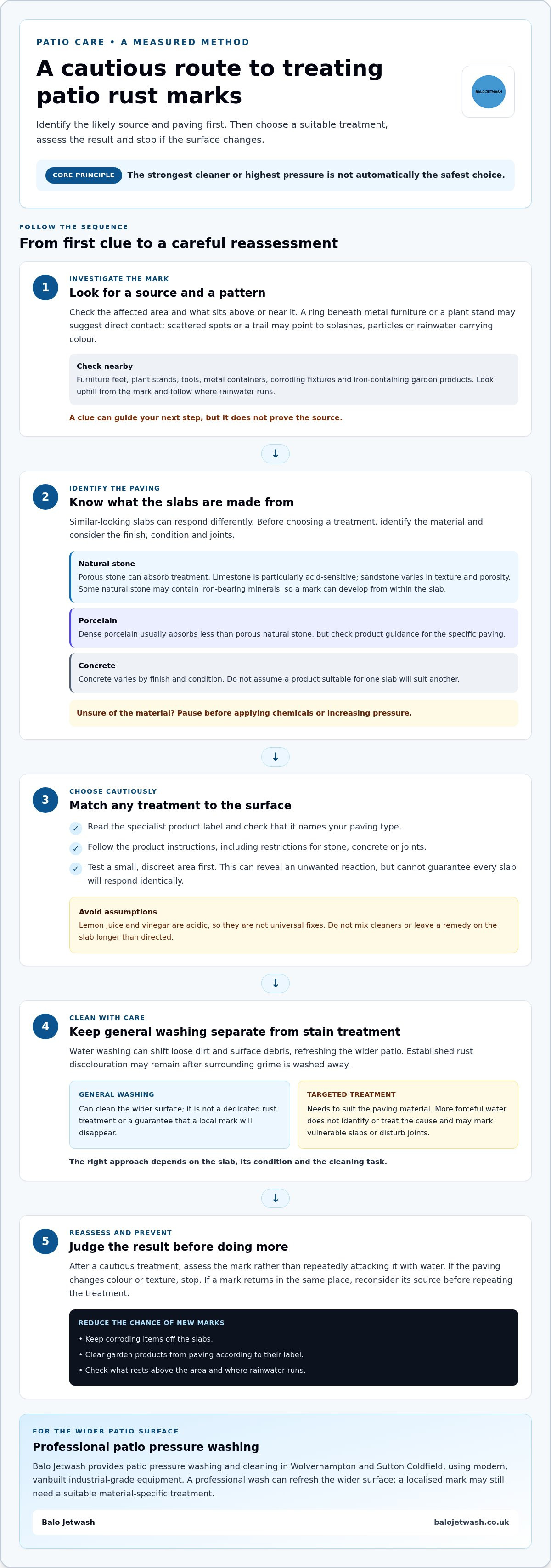
Identify the paving material before choosing any stain treatment. A product that suits one surface may mark another, so don’t assume a familiar household remedy or stronger cleaner is automatically safe. If you’re unsure what the slabs are made from, pause before applying chemicals or increasing the pressure. The finish and the joints matter too.
Why paving material changes the treatment
Porous natural stone can absorb a treatment, while dense porcelain usually absorbs less. But natural stone includes different materials, and they don’t all respond alike. Limestone is particularly acid-sensitive; sandstone varies in texture and porosity. Concrete also differs according to its finish and condition, so don’t assume a product safe for one concrete slab will suit another.
Before using a specialist rust remover, read the label carefully. Check that it names your paving type and follow its instructions, including any restrictions for stone, concrete or joints. Unsuitable products can etch a surface, alter its colour or damage the material between slabs. Testing a small, discreet area can reveal an unwanted reaction, though it can’t guarantee that every slab will respond identically.
Household ingredients aren’t universal fixes. Lemon juice and vinegar are acidic, and their suitability depends on the paving and product guidance. Don’t mix cleaners or leave a remedy on the slab for longer than directed. If the surface is unknown, delicate or already worn, identify it before experimenting across a visible area.
What pressure washing can and can’t do
Water washing can shift loose dirt and surface debris, helping the patio look cleaner overall. Established rust discolouration is different. It may remain in the surface after surrounding grime has been washed away, so general patio washing shouldn’t be treated as a dedicated rust treatment or a promise that a local mark will disappear.
Resist the temptation to turn up the pressure to compensate. A more forceful jet doesn’t identify or treat the cause; it may instead mark vulnerable paving or disturb the joints. The right approach depends on the slab, its condition and the cleaning task. Keep broad cleaning separate from targeted stain treatment, and reassess the mark rather than repeatedly attacking it with water.
For general patio washing, Balo Jetwash’s patio pressure washing and cleaning uses modern, vanbuilt industrial-grade equipment. A professional wash can refresh the wider surface, while a localised rust mark may need a suitable material-specific treatment. Stop if the paving changes colour or texture.
A Careful Step-by-Step Way to Treat a Rust Mark
A measured approach helps protect the paving and makes it easier to judge whether treatment is working. Follow the steps below, and don’t rush into treating the whole mark. If you can’t identify the slab material or find a product labelled as suitable for it, pause rather than guess.
Remove the likely source. Move the furniture, plant stand, tool or container that may be causing the mark. Lift it rather than dragging it across the patio. Pick up loose debris gently and avoid spreading coloured residue over clean slabs. Check the surface and product instructions. Choose a rust treatment whose label allows use on your paving material. Read all directions, including restrictions for stone, concrete or joints. Check how to apply it, how long it should remain and how to rinse it. Don’t guess a dilution or dwell time. Test a discreet patch. Apply the product to a small, inconspicuous area of the same paving, following the label. This is a useful first check, not a guarantee that every slab will react the same way. Stop if the test area changes colour or texture, or if the surface appears marked. Treat only the affected area. If the test looks acceptable, apply the product as directed to the stain. Keep it within the intended area and avoid splashing it onto nearby slabs, metalwork or plants. Don’t combine it with another cleaner, scrub more aggressively than the label allows or use a pressure washer instead of the specified treatment. Rinse and assess after drying. Rinse exactly as the product instructions say, taking care not to direct residue into planted areas. Allow the paving to dry fully before deciding what to do next. A wet slab can make remaining discolouration difficult to judge.
Assess the result when the slab is fully dry. Moisture can disguise how much of the mark remains. If it’s still visible, don’t automatically repeat the process. Recheck the product guidance and consider whether you’ve identified the stain’s source and paving material correctly. Stop if the surface looks altered or you’re uncertain about the next step.
Targeted stain treatment is different from washing the whole patio. General cleaning can refresh the wider surface, but it doesn’t guarantee removal of a localised mark. For broader patio pressure washing and cleaning, Balo Jetwash uses modern, vanbuilt industrial-grade equipment. Keep treatment specific to the mark and use whole-patio washing for the wider clean.
How to Prevent Rust Marks Returning to Patio Slabs
A quick patio check can help you spot new sources before they leave another conspicuous mark. Focus on metal items resting directly on the slabs, then look for fresh colour after wet weather. Prevention has limits: removing contact with external metal can reduce new transfers, but it won’t reverse discolouration that originates within a slab.
Reduce contact between metal items and paving
Check furniture feet, plant stands, tools and containers for visible corrosion. Move affected items off the slabs and avoid leaving corroding metal in direct contact with the paving. Damp conditions can help colour transfer, so reducing prolonged wet contact is sensible. After rain, inspect beneath these items and along any route where water may have carried colour.
Check contact points: Look beneath chair and table feet, plant stands, stored tools and metal containers. Move corroding items: Don’t leave corroding metal resting directly on the slabs. Relocate it to prevent further contact. Inspect after wet weather: Look for fresh rings, spots or colour spread around the item and in the direction rainwater runs. Clear product spills promptly: If an iron-containing garden product lands on the patio, follow its label for safe handling and clear it as directed.
Make the inspection part of your usual outdoor tidy-up, especially after moving furniture or using garden products. A small mark can be easier to trace when you notice where it first appears. Don’t automatically scrub or rinse an unidentified spill; follow the product label for appropriate handling.
Respond early to spills and recurring marks
If a mark returns, note its exact position and what sits above it or drains towards it. A written note or dated photograph can help you see whether the same spot is affected each time. That pattern is useful, but it doesn’t prove the cause. Avoid repeating a treatment simply because the colour has reappeared.
Recurring marks may mean an external source is still present, or that the discolouration is associated with material within the paving. Prevention can remove likely sources of new transfer, but it can’t change what is already within a slab. If marks keep returning or appear to emerge from the paving, pause DIY treatment and seek professional advice before applying another product.
Keeping the patio generally clean can make fresh marks easier to notice, though pressure washing isn’t a guarantee that a localised stain will disappear. For patio care in Sutton Coldfield and Wolverhampton, Balo Jetwash provides professional patio pressure washing. A regular check-and-clear routine, combined with cautious treatment when needed, can help you spot new sources early and protect the appearance of your paving.
When Sutton Coldfield Patio Cleaning Can Help
A localised rust mark and a generally dirty patio are different challenges. Balo Jetwash provides Patio Pressure Washing & Cleaning in Sutton Coldfield and Wolverhampton, helping refresh the wider paved area with modern, vanbuilt industrial-grade equipment. Pressure washing can remove stubborn dirt, algae and moss, but general patio washing doesn’t promise that every rust mark will be removed. A mark may need a separate treatment suitable for the paving, particularly if it has settled into the surface.
What to expect from professional patio pressure washing
The aim is to clean the patio as a whole, rather than guarantee a result for one particular mark. The service includes free re-sanding with Klin dried sand and free licensed industrial cleaning detergent. If water is needed, the team can provide it, so you don’t need to arrange a supply yourself.
Domestic patio cleaning costs £4 per square metre, with a £100 minimum charge. The final price is confirmed through a personalised quotation and can vary by location, material type and job scale. Balo Jetwash has £5,000,000 public-liability insurance, offers free personalised quotations and provides the Shine Guarantee. These details help set expectations for the wider clean, whilst recognising that a specific area of discolouration may need separate attention.
Deciding whether to request a local quotation
A personalised quotation can be useful if marks cover a wide part of the patio, the surface is difficult to identify, or DIY testing could risk changing its colour or texture. It also gives you a chance to discuss the paving’s condition and the difference between cleaning the whole area and tackling a localised mark. Pressure washing alone isn’t a promise that a particular mark will disappear.
If you’re considering how to treat patio discolouration, keep the material and likely cause in mind before choosing a product. A broader professional clean may still make the surrounding paving look fresher, even if a particular mark needs separate attention. For homeowners in Sutton Coldfield and Wolverhampton, Balo Jetwash’s patio pressure washing service can refresh the overall surface.
If a cautious DIY test feels too risky or the discolouration is widespread, request a free, no-obligation patio cleaning quotation. You can discuss the wider clean, understand the listed pricing and decide on a sensible next step without assuming pressure washing guarantees complete stain removal.
Take the Next Step Towards a Fresher Patio
A rust mark can be frustrating, but rushing to treat it may create a bigger problem for the paving. Consider the slab material and likely source first. For patio slabs in Sutton Coldfield and Wolverhampton, choose a cautious treatment suited to the surface and stop if the paving changes colour or texture.
Professional pressure washing can refresh the surrounding patio, though it can’t guarantee that a particular mark will disappear. Balo Jetwash offers a free, personalised quotation for patio cleaning. Discuss the overall condition of your paving and decide whether a professional clean is right for your space.
Request your free patio-cleaning quotation or call Balo Jetwash on 07902 932947 to take a confident step towards a cleaner, more welcoming patio.
Frequently Asked Questions
What causes rust stains on patio slabs?
Rust-coloured marks often come from iron-bearing items or materials contacting paving. A chair foot may leave a ring, whilst iron-containing garden product granules can create spots if scattered over damp slabs. Rainwater may carry the colour beyond its source. If a mark appears without an obvious nearby object or returns in the same place, its source may be less visible than a surface item.
Can pressure washing remove rust stains from patio slabs?
Pressure washing can lift loose dirt and improve the wider patio’s appearance, but established rust discolouration may remain. Increasing the pressure isn’t a dependable stain treatment and could affect vulnerable paving or joints. Before washing, check whether affected slabs are loose, cracked or worn. If you’re unsure how the surface will respond, don’t experiment with stronger pressure; seek professional advice about a suitable next step.
Is vinegar safe for removing rust from patio slabs?
Vinegar isn’t suitable for every paving surface. It’s acidic, and an unsuitable acidic cleaner may etch or discolour acid-sensitive stone. Don’t apply it across the patio simply because it’s a familiar household ingredient. Check the paving type and cleaner guidance first, then test an inconspicuous area. Avoid mixing vinegar with other cleaning products, and stop if the test patch looks different after rinsing and drying.
How do I remove rust stains from natural stone paving?
First identify the stone as accurately as possible, using installation records or spare slabs if available rather than guessing from appearance. Choose only a treatment labelled as suitable for that surface, test it discreetly and follow the application and rinse directions. Natural stone types can react differently to cleaners. If the mark is widespread, returns or seems to emerge from within the stone, pause DIY attempts and seek experienced advice.
Why do rust stains come back after cleaning?
A recurring mark may mean a source remains nearby, such as an item still touching the paving or garden product residue. It may also be associated with material within the slab. Note where it appears and compare the location after the paving has dried. This can help reveal a pattern. Don’t respond by simply applying a stronger cleaner; reassess the cause before choosing another treatment.
How much does patio pressure washing cost in Sutton Coldfield?
Balo Jetwash lists domestic patio pressure washing at £4 per square metre, with a £100 minimum charge. The final price is confirmed through a personalised quotation and can vary with the patio’s location, material and job scale. A general patio wash can refresh the wider surface, but it doesn’t guarantee that a particular rust mark will disappear. The team can provide water if required.
Can I use a rust remover on porcelain patio slabs?
Use a rust remover only if its label specifically states that it’s suitable for porcelain paving. Don’t assume a product intended for natural stone will also suit porcelain. Test an inconspicuous area and check the finish after rinsing and drying. If the test changes the colour or texture, stop rather than treating the visible mark. Follow the product’s instructions throughout, including its application and rinsing guidance.
{"@context":"https://schema.org","@type":"FAQPage","mainEntity":[{"@type":"Question","name":"What causes rust stains on patio slabs?","acceptedAnswer":{"@type":"Answer","text":"Rust-coloured marks often come from iron-bearing items or materials contacting paving. A chair foot may leave a ring, whilst iron-containing garden product granules can create spots if scattered over damp slabs. Rainwater may carry the colour beyond its source. If a mark appears without an obvious nearby object or returns in the same place, its source may be less visible than a surface item."}},{"@type":"Question","name":"Can pressure washing remove rust stains from patio slabs?","acceptedAnswer":{"@type":"Answer","text":"Pressure washing can lift loose dirt and improve the wider patio’s appearance, but established rust discolouration may remain. Increasing the pressure isn’t a dependable stain treatment and could affect vulnerable paving or joints. Before washing, check whether affected slabs are loose, cracked or worn. If you’re unsure how the surface will respond, don’t experiment with stronger pressure; seek professional advice about a suitable next step."}},{"@type":"Question","name":"Is vinegar safe for removing rust from patio slabs?","acceptedAnswer":{"@type":"Answer","text":"Vinegar isn’t suitable for every paving surface. It’s acidic, and an unsuitable acidic cleaner may etch or discolour acid-sensitive stone. Don’t apply it across the patio simply because it’s a familiar household ingredient. Check the paving type and cleaner guidance first, then test an inconspicuous area. Avoid mixing vinegar with other cleaning products, and stop if the test patch looks different after rinsing and drying."}},{"@type":"Question","name":"How do I remove rust stains from natural stone paving?","acceptedAnswer":{"@type":"Answer","text":"First identify the stone as accurately as possible, using installation records or spare slabs if available rather than guessing from appearance. Choose only a treatment labelled as suitable for that surface, test it discreetly and follow the application and rinse directions. Natural stone types can react differently to cleaners. If the mark is widespread, returns or seems to emerge from within the stone, pause DIY attempts and seek experienced advice."}},{"@type":"Question","name":"Why do rust stains come back after cleaning?","acceptedAnswer":{"@type":"Answer","text":"A recurring mark may mean a source remains nearby, such as an item still touching the paving or garden product residue. It may also be associated with material within the slab. Note where it appears and compare the location after the paving has dried. This can help reveal a pattern. Don’t respond by simply applying a stronger cleaner; reassess the cause before choosing another treatment."}},{"@type":"Question","name":"How much does patio pressure washing cost in Sutton Coldfield?","acceptedAnswer":{"@type":"Answer","text":"Balo Jetwash lists domestic patio pressure washing at £4 per square metre, with a £100 minimum charge. The final price is confirmed through a personalised quotation and can vary with the patio’s location, material and job scale. A general patio wash can refresh the wider surface, but it doesn’t guarantee that a particular rust mark will disappear. The team can provide water if required."}},{"@type":"Question","name":"Can I use a rust remover on porcelain patio slabs?","acceptedAnswer":{"@type":"Answer","text":"Use a rust remover only if its label specifically states that it’s suitable for porcelain paving. Don’t assume a product intended for natural stone will also suit porcelain. Test an inconspicuous area and check the finish after rinsing and drying. If the test changes the colour or texture, stop rather than treating the visible mark. Follow the product’s instructions throughout, including its application and rinsing guidance."}}]}
Information
Water available? - You don't need to be present for us to carry out the service. If required, we can supply water ourselves.
Insurance
Balo Jetwash is fully insured, We have £5,000,000 of public liability insurance. Balo Jetwash operatives are professional, reliable and endeavour to carry out the work to the highest standard with minimal fuss and upheaval.